

 Language
 Language
Quick transportation
We cooperate with professional sea shipping, air and logistics companies to provide you with the best transportation solution.
Good services
Customer service will update you the logistics information of the goods in time to ensure that the goods are delivered in time.
Professional team
We have a team of skilled and experienced professionals who are well-versed in the latest technology and industry standards. Our team is dedicated to ensuring that our customers get the best service and support possible.
Competitive prices
We offer our products at competitive prices, making them affordable for our customers. We believe that high-quality products should not come at a premium, and we strive to make our products accessible to all.
Rich experience
Has a long-standing reputation in the industry, which makes it stand out from its competitors. With over many years of experience, they have developed the skills necessary to meet their clients' needs.
High quality products
We always put customer needs and expectations in the first place, refine on, continuous improvement, to seek every opportunity to do better, to provide customers with their expectations of quality products, to provide customers with the most satisfactory service at anytime.
Five types of steel fibers exist
You've probably already guessed that steel fiber concrete gets its name from the addition of thin strands of steel. Generally speaking, these short pieces of wire boost the overall strength and stability of the concrete. That said, the performance of the concrete depends a lot on the attributes of the particular steel fiber used.
The steel fibers used to reinforce concrete come in five different types and differ in terms of their production. For instance, Type I fibers consist of cold-drawn wires, while Type III Fibers consist of melt-extracted steel. Each type of fiber boasts a slightly different tensile strength. Likewise, different types have slightly different shapes, which contractors often refer to as aspect ratios.
A contractor must closely consider such properties when selecting the best type of fiber for a given project. Another key factor involves the average length of the fibers. While longer fibers tend to result in stronger concrete, they present more difficulties for mixing. Contractors can more easily and evenly distribute shorter fibers in a concrete mix.
Steel fibers increase strength in numerous ways
As noted above, the chief advantage of steel fiber concrete lies in its greater strength as compared to conventional concrete. The steel fibers boost strength in a number of key ways. First of all, they improve the hardened concrete's flexural strength. In other words, steel fibers allow the concrete to resist bending forces up to 3 times better than conventional concrete.
This property makes steel fiber concrete a great choice for applications such as building floors and bridge decks. Steel fibers also boost the concrete's fatigue resistance by almost 1.5 times. Fatigue involves the tendency to rupture beneath repeated loadings. Compression, torsion, and bending forces all contribute to concrete fatigue.
Finally, cured steel fiber concrete exhibits greater strength when it comes to resisting impact and abrasive forces. Impact forces happen when heavy objects strike the surface of the concrete. Abrasion includes surface-level friction and wear, as well as processes like spalling, which can leave the top layer of concrete pitted and rough.
Steel fibers reduce shrinkage cracks
Steel fibers also directly benefit concrete before it has reached a hardened state. Specifically, those metal fibers decrease the likelihood of plastic shrinkage cracks. Plastic shrinkage cracks occur when water evaporates out of the curing concrete at a greater rate than it rises up to the surface.
This accelerated evaporation causes a volume decrease at the top of the concrete. This volume change creates shrinkage forces that often result in small cracks on the surface. While steel fibers cannot eliminate this volume change, they give the concrete the extra boost of strength necessary to hold together under such forces.
To best resist plastic shrinkage cracks, a contractor must add a certain percentage of steel fibers. Shape, or aspect ratio, also plays an important role in reducing the total cracked area.
Types of Steel Fiber
There are three main types of steel fiber used in concrete
Hooked End Steel Fiber
This type of fiber has a hooked end that is designed to grab onto the concrete and enhance its bond strength. It is commonly used in industrial flooring, tunnel linings, and precast concrete elements.
Straight Steel Fiber
Straight steel fibers are longer and thinner compared to hooked end fibers, and they are used to improve the tensile strength of the concrete. They are ideal for applications where the concrete is subjected to heavy loads or high temperatures.
Crimped Steel Fiber
Crimped steel fibers are designed to increase the bending strength of the concrete. They have multiple bends along their length, which helps to evenly distribute the load across the concrete surface. This type of fiber is commonly used in shotcrete applications.

Steel fibers have a wide range of applications in the construction industry, including:
Industrial flooring
Steel fiber reinforced concrete is commonly used in industrial flooring as it can withstand heavy traffic and heavy loads from machinery. The fibers also provide high impact and abrasion resistance, making it suitable for demanding industrial environments.
Overlaying existing concrete
Steel fibers can be used to overlay existing concrete surfaces, providing increased strength and durability. This is a cost-effective way to enhance the performance of old or damaged concrete without having to completely replace it.
Tunnel linings
Steel fibers are used in the construction of tunnel linings to prevent cracking and increase the strength of the concrete. The fibers also improve the resistance to fire and blast effects, making them a popular choice for underground structures.
Precast concrete elements
Steel fiber reinforced concrete is commonly used in the production of precast elements such as walls, beams, and columns. The addition of fibers improves the overall structural integrity and reduces the risk of damage during transportation and installation.
Shotcrete
Shotcrete is a common method of applying concrete to vertical or overhead surfaces. Steel fibers are added to the concrete mix to increase its strength and prevent the formation of cracks.
The global steel fiber market size was USD 2.30 illion in 2022 and is expected to register a rapid revenue CAGR of 4.8% during the forecast period. Rising infrastructuraldevelopment across various regions and increasing use of steel fibers due to higher tensile strength are key factors driving market revenue growth.
Steel fiber is defined as the short or discrete length of steel wire that are basically mixed in concrete. These are used for providing strength and increasing resistance tocracking and other properties in the concrete. Government and private players have been investing heavily in various infrastructure projects and despite a shift ingeopolitical scenario in 2022, construction companies operating globally have witnessed growth significantly.
Steel fibers are extensively used along with mesh and steel reinforcing bars in various construction applications owing to their compression, splitting tensile, and flexuralstrength.. Variables, such as shape, size, volume, proportion, and distribution of fibers are used to determine how good the mechanical properties of Steel FiberReinforced Concrete (SFRC) are compared to ordinary concrete. In addition, steel fiber concrete can provide higher resistance to reduce cracks in hardened concrete andwithstand dynamic and static load effectively. This is expected to rise demand for steel fibers for infrastructure activities, which is also expected to drive revenue growthof the steel fiber market.
SFRC can sustain pressure from loads, such as heavy machines or cars passing over, better than ordinary concrete because of higher tensile strength. The steel fiberslessen the likelihood of cracking that can happen when conventional concrete is subjected to harsh weather or other environmental factors. Moreover, the material ismore flexible due to steel fibers, which reduces the likelihood of a crack under pressure. The cost-effectiveness of SFRC is an additional advantage, as it does not requireextra reinforcement such as rebar or mesh. This kind of concrete is a flexible choice for any building project because this may be used for foundations, walls, floors,driveways and others.
Raw Materials
The raw materials used in the steel fiber manufacturing process are typically low-carbon steel or stainless steel. Low-carbon steel is the most commonly used material, as it is cost-effective and provides good strength and durability. Stainless steel is used in applications where corrosion resistance is a concern.
Melting
The first step in the process is the melting of the raw materials. The steel is melted in a furnace at high temperatures, typically between 1600°C and 1800°C. Once the steel has melted, it is poured into a casting machine.
Casting
The casting machine is used to form the steel into a thin strand. The steel is poured into a mold, which is then cooled to form a solid strand. The strand is then fed through a drawing machine.


Drawing
The drawing machine is used to stretch the steel strand into a thinner and longer strand. The steel strand is drawn through a series of dies, which progressively reduce its diameter. The final diameter of the steel fiber is determined by the size of the last die in the drawing process.
Cutting
Once the steel fiber has been drawn to the desired diameter, it is cut to the desired length. The length of the steel fiber depends on the application and can range from a few millimeters to several centimeters.
Packaging and Shipping
The final step in the steel fiber manufacturing process is the packaging and shipping of the steel fibers. The steel fibers are typically packaged in bags or boxes and shipped to construction sites or distributors.
Quasi-brittleness is an important factor affecting the size effect of concrete. The addition of steel fibers can effectively change the quasi-brittleness of concrete. Effect of size effect on the fracture energy of high-strength concrete reinforced with steel fibers. The size effect of the fracture energy of high-strength concrete reinforced with steel fibers was studied by experimentally studying 156 single-edge notched concrete beams (SENB) with different span-to-height ratios, crack depth ratios and steel fiber content. The fracture parameters in the boundary effect model (BEM) and the size effect law (SEL) were analyzed in depth. The results show that the addition of steel fibers has a significant effect on the parameter values obtained by BEM and SEL. Based on BEM, the relationship between Gf (test fracture energy), gf (local fracture energy) and GF (fracture energy not affected by the specimen boundary) can be obtained. A method for analyzing the effect of steel fibers on GF using laboratory small-sized SENB specimens is proposed. In addition, based on SEL, the addition of steel fibers to high-strength concrete can effectively mitigate the influence of size effect on fracture energy to a certain extent.
Zhejiang Boen Metal Products Co., Ltd.
Established in 2009, factory area 17000m2.
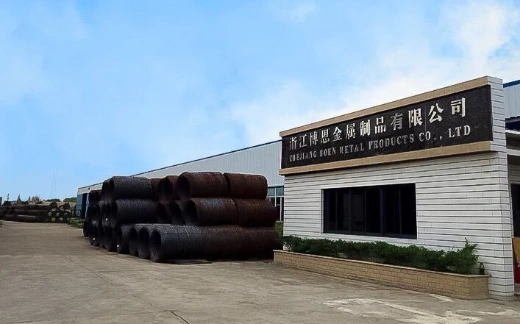


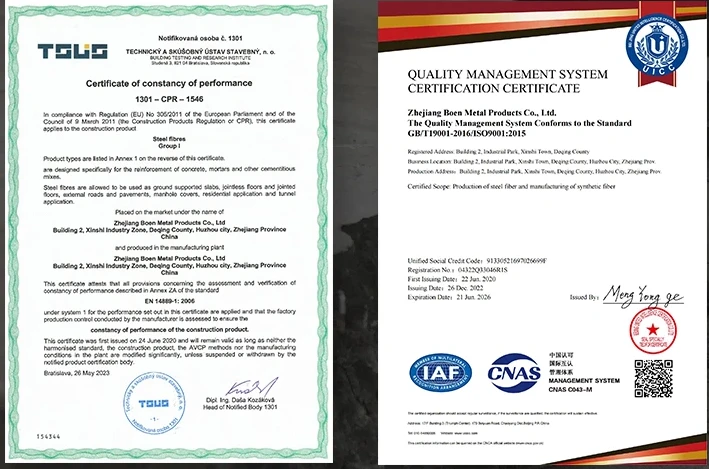
As one of the most professional steel fiber manufacturers and suppliers in China, we're featured by quality products and competitive price. Please rest assured to buy bulk steel fiber from our factory.
sheared concrete reinforced with steel fibers, hooked end steel fiber anti corrosion, concrete reinforcement steel fiber hooked end(0/10)
